


For manufacturers and distributors, the old playbook for going digital is breaking down. Eighteen-month implementation timelines. Millions of dollars for a platform built for a world that no longer exists. A tangle of custom middleware duct-taped to legacy systems that nobody wants to touch for fear of breaking something.
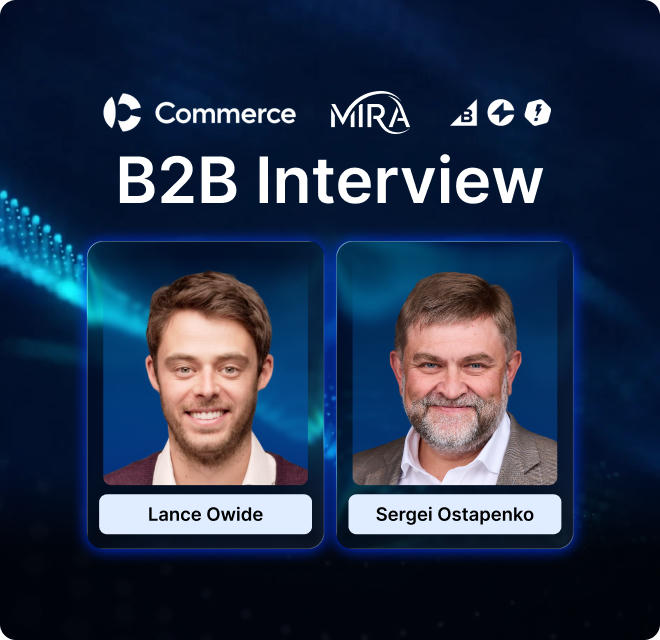
In the latest episode of our interview series, Mira Commerce CEO Sergei Ostapenko sat down with Lance Owide, VP of Product, B2B at BigCommerce (now operating under the commerce.com brand), to talk about where B2B ecommerce is actually headed. Lance's path to this seat wasn't the obvious one. He started in asset management and investment banking at UBS, moved into private equity buying and modernizing insurance companies, then took a detour building his own consumer scheduling app before landing at BigCommerce during its Feedonomics acquisition. Four years ago, he made the case internally that B2B deserved dedicated focus rather than a patchwork of bolt-on apps, and he's been building that practice ever since.
What "true" B2B actually means
One of the more useful distinctions Lance draws is that not all B2B is created equal. A shoe brand selling wholesale to a retailer is technically B2B, but it's a relatively simple use case. The real complexity lives with manufacturers and distributors selling components and products that other businesses depend on to keep running: a clamp used across production warehouses, a part that stops a car assembly line if it doesn't arrive on time, materials specified down to the detail on a construction purchase order. That's where complex pricing, custom catalogs, ERP integrations, and multi-location logistics all collide, and it's the problem set BigCommerce has chosen to specialize in.Buy vs. build, and the case for "curated composability"
Sergei pushed Lance on where BigCommerce sits between two extremes: fully open, API-only platforms like commercetools that give you a toolkit but require you to build everything yourself, and monolithic systems like SAP that do a lot out of the box but calcify the moment you customize them. Lance described BigCommerce's positioning as "curated composability," a SaaS backbone that lets a business spin up a storefront quickly while still supporting the unique workflows their operation requires. He pointed to BioRad, a multi-billion dollar life sciences manufacturer selling in over 130 countries, as an example of a company that outgrew a heavily customized legacy platform and needed that flexibility back without starting from zero on a headless build.
That same philosophy shapes how BigCommerce thinks about its role in a B2B tech stack. Lance was direct about it: BigCommerce isn't trying to replace the ERP, the CRM, or the PIM. It sees itself as an extension of the ERP, reflecting what's already true there rather than becoming a new system of record. In B2B, ecommerce is often a smaller slice of how transactions actually happen (EDI, phone, email, fax are all still very much alive), and Lance argued that pretending otherwise is where a lot of platforms overpromise.Where AI is headed in B2B
The conversation's most forward-looking stretch was about agentic commerce. While B2C is racing to optimize for AI-driven discovery, Lance thinks B2B is going to move even faster, because B2B purchasing is about efficiency, not experience. He described a near future where a buying agent and a selling agent transact directly, with a human in the loop but not required to approve every order. The hard part isn't payment protocols like AP2; it's giving an AI reliable access to a buyer's specific catalog, pricing, roles, and approval rules. BigCommerce is building toward that through its MCP server, which lets AI tools browse a storefront and complete checkouts directly, and through Feedonomics, which is extending beyond feeding marketplaces into helping downstream systems and LLMs consume much richer product data.
Lance was careful to note none of this is solved yet. He estimates roughly 30 percent of manufacturers and distributors in the US still don't transact online at all, and plenty of others sank hundreds of thousands of dollars into implementations that collapsed under their own complexity. His advice to operators evaluating a re-platform: get a subset of customers online fast, prove ROI, and iterate. Avoid anyone selling a big-bang solution that promises to fix everything in one project, and ask every platform vendor the uncomfortable question: what can't you do?
That last piece of advice is one we tell clients constantly. The right platform decision has less to do with checking every box on a feature matrix and more to do with finding a partner who's honest about the tradeoffs and whose incentives are actually aligned with your growth.
If you're a manufacturer or distributor weighing where B2B ecommerce is headed, or trying to figure out whether your current platform can carry you through the next five years, we'd be glad to talk it through. Reach out to Mira Commerce to start the conversation.




.webp?compression=lossy)
.webp?compression=lossy)